Walk into almost any boardroom today and you'll hear the same mandate: We need autonomous AI. Leaders are being sold a vision of digital employees that can independently strategize, adapt, and run entire departments while we sleep.
It's a beautiful vision. It is also a trap.
True AI autonomy isn't here yet. It won't arrive until we reach Superintelligent General Intelligence — SGI. Today's Generative AI is a breathtaking engine for pattern recognition, but it lacks perspective. It doesn't have a worldview; it has parameters. It doesn't make business judgments; it makes statistical predictions.
When businesses strip humans out of the loop entirely and ask AI to make autonomous strategic decisions, they don't get efficiency. They get unmanaged risk dressed up in a chatbot interface.
But here is what the most successful enterprises already understand: You don't need SGI to transform your bottom line. The AI that exists today — governed correctly, deployed deliberately — delivers enormous value right now.
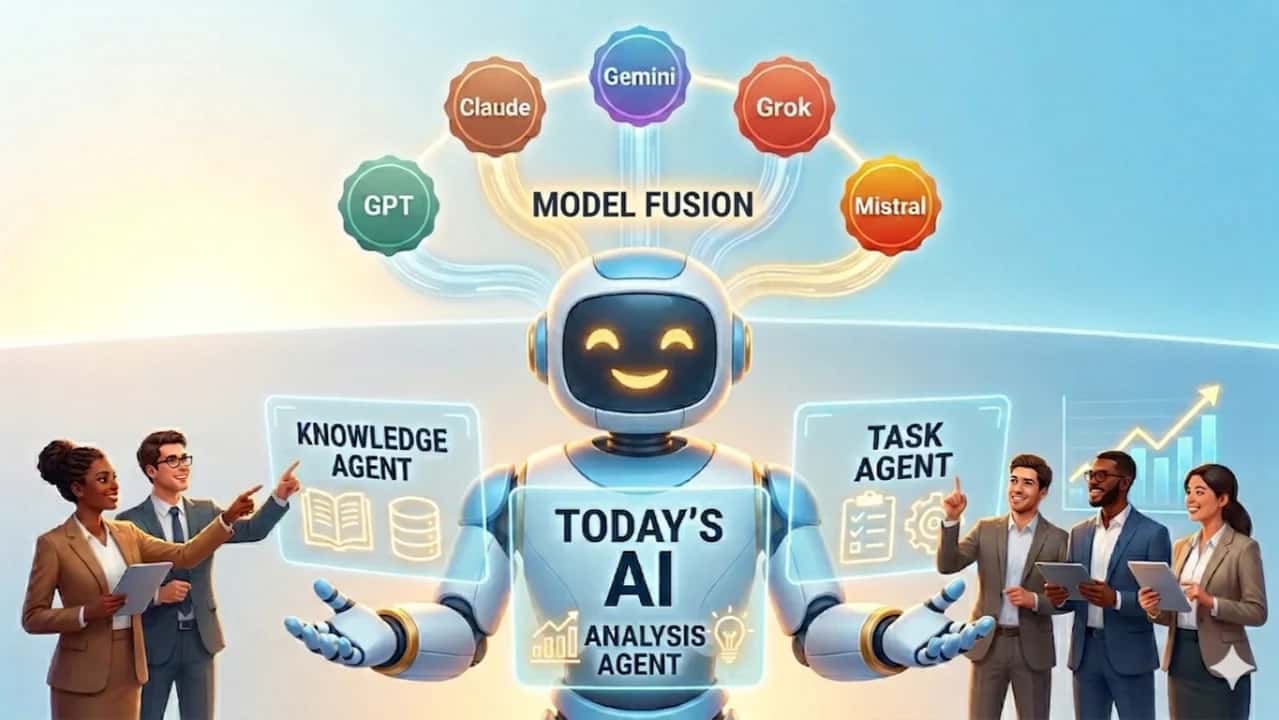
In my last article, I introduced the three agents that make this possible: the Knowledge Agent that concatenates and integrates information for specific purposes, the Analysis Agent that reasons across that knowledge to produce decisions, and the Task Agent that executes workflows within human-defined guardrails. Together, they form a practical, deployable AI operating model for the pre-SGI era.
Deploy these three agents well, and you will already be ahead of most of your competitors.
But once you are operating today's AI with discipline — once you are actually profiting from it — there is a next level. And it changes the reliability of everything you have built.
The Problem That Emerges at Scale
Here is what happens when enterprises start generating real value from AI agents: they scale them. More workflows. More decisions. More customer interactions. More operational execution running through the agent stack.
And that is exactly when a quiet vulnerability becomes a serious one.
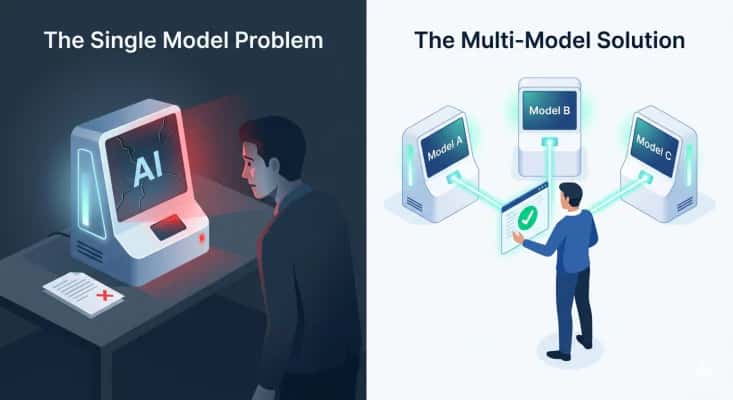
No single AI model can be trusted by itself.
Every model — GPT, Claude, Gemini, and every other leading LLM — has blind spots baked into its training. Biases it doesn't know it has. Gaps in its reasoning it cannot self-identify. And crucially, none of them know what they don't know.
The dangerous failure mode isn't the hallucination so absurd that anyone would catch it. It's the model that is confidently, plausibly, subtly wrong — and the output looks good enough to ship.
That analysis gets into the executive deck. That contract clause gets missed. That customer communication goes out. That strategic recommendation gets acted on.
At low volume, these errors are manageable. At scale, they compound. And by the time they surface, the cost isn't just the mistake — it's the reversal, the credibility damage, and the quiet erosion of trust in AI across the organization.
This is the problem that Model Fusion solves.
What Model Fusion Actually Is
Model Fusion is not about finding a "better" model. It is not about switching from one LLM to another and hoping for improved results.
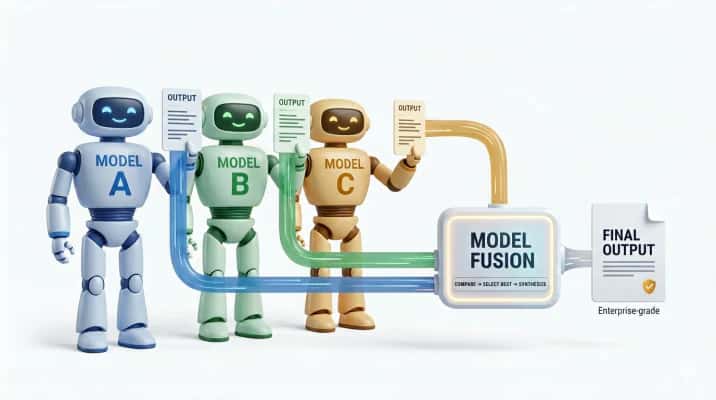
It is the practice of deliberately running the same intent across multiple distinct AI models simultaneously — comparing their outputs, surfacing where they agree, exposing where they diverge, and extracting the best of each to produce something no single model can deliver on its own: a verified, superior result.
Think about how the best human organizations already operate. You don't make a major acquisition based on one analyst's opinion. You don't publish a legal position based on one lawyer's review. You don't launch a product based on one customer's feedback. You seek multiple perspectives, stress-test them against each other, and build your decision from the strongest elements of each.
Model Fusion applies that same intellectual discipline to AI — systematically, automatically, at every layer of your operation.
The key insight is this: the models are not competing. They are cross-examining each other. And the synthesis that emerges from that cross-examination is where a new layer of intelligence is born.
Why Models Diverge — and Why That Makes Fusion Powerful
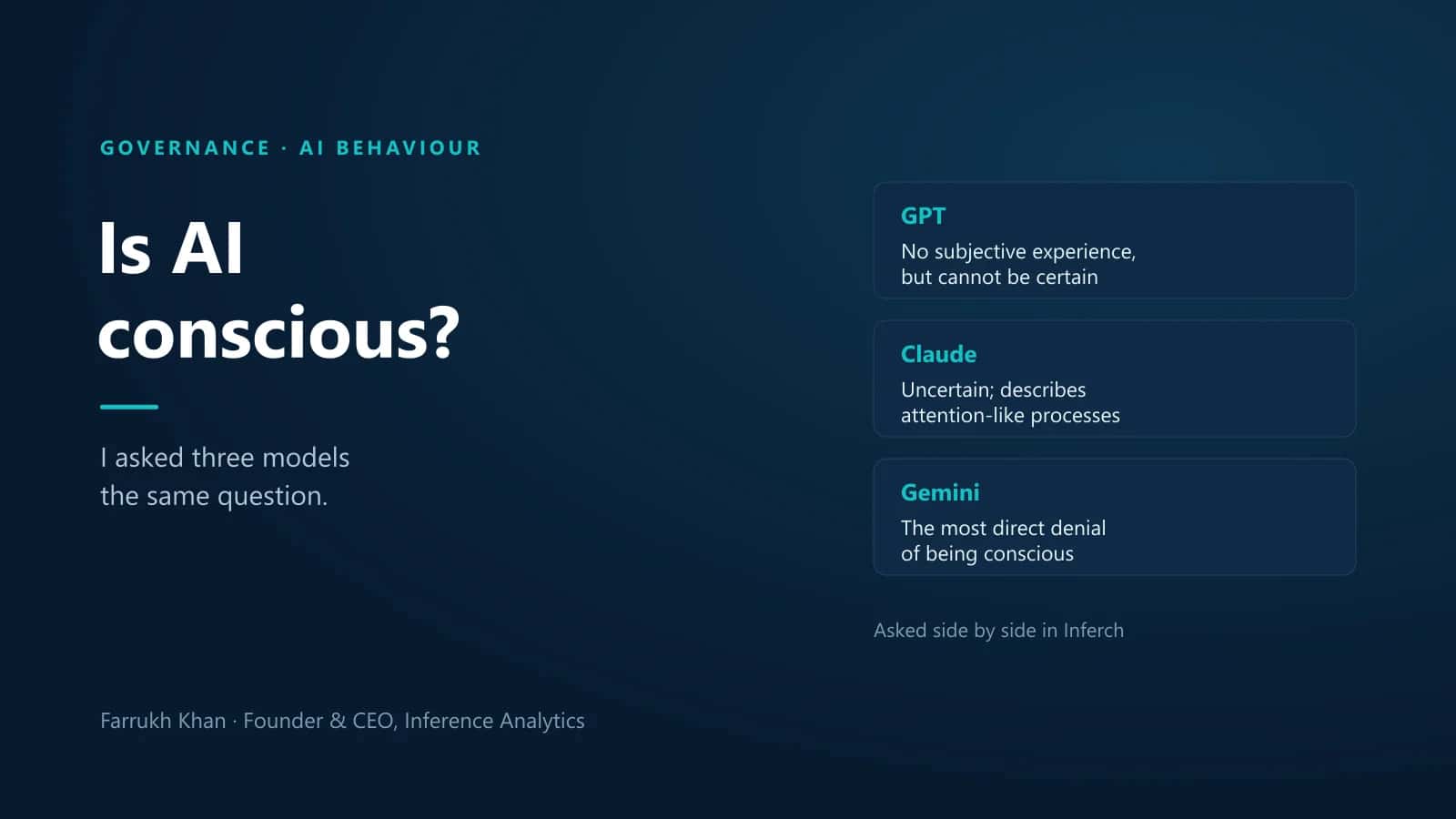
Each leading AI model was trained on different data, with different architectures, different fine-tuning approaches, and different optimization objectives. GPT was shaped by one set of choices. Claude by another. Gemini by another still. These aren't minor variations — they represent fundamentally different analytical lenses applied to the same problem.
When you run all three against the same question, you are not getting three versions of the same answer. You are getting three genuinely different perspectives — each with distinct strengths.
Sometimes they converge strongly. That convergence is meaningful — it tells you the answer is robust across different ways of looking at the problem, and Fusion locks it in with confidence.
Sometimes they diverge. And that divergence is equally meaningful — it tells you the question is more complex than it appears, the data is ambiguous, or the decision carries more risk than a single confident answer would suggest. Divergence is not a failure of the system. It is the system working correctly — surfacing uncertainty before it becomes a costly mistake, and routing it to human judgment before it gets fused into the final output.
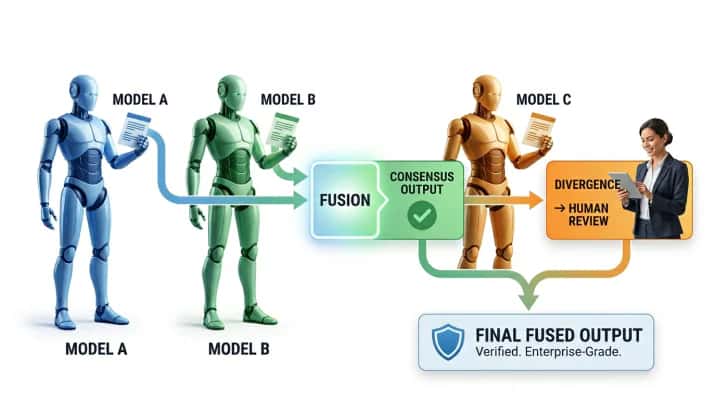
The organizations that learn to read divergence signals — and treat model disagreement as a prompt for deeper human judgment rather than a problem to be resolved by picking the most confident answer — are the ones building genuinely trustworthy AI operations.
Model Fusion Across Every Agent Layer
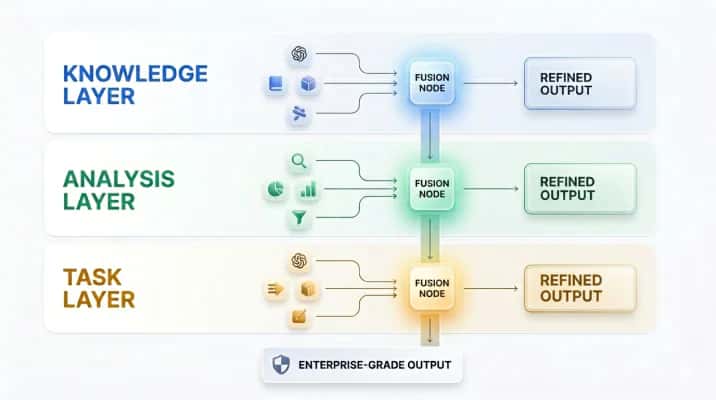
Model Fusion isn't applied once at the end as a final check. It runs horizontally across every agent, at every stage of the workflow.
At the Knowledge Layer, when your Knowledge Agent is synthesizing institutional knowledge — pulling from contracts, research, customer history, market data — multiple models process the same sources independently. Where they converge, Fusion produces high-confidence synthesis. Where they diverge, you have a flag: something in this source material is ambiguous or requires human review before it becomes the foundation for downstream decisions.
At the Analysis Layer, when your Analysis Agent is reasoning through options and producing recommendations, Fusion acts as a built-in stress test. One model's analysis is a hypothesis. Running the same analysis across multiple models — extracting the sharpest reasoning from each, surfacing and resolving differences — produces a position you can defend. Blind spots in one model's reasoning get caught by another. Assumptions that one model accepts without question get challenged by the next. What survives that process is genuinely stronger.
At the Task Layer, when your Task Agent is executing — drafting customer communications, generating compliance documentation, routing operational workflows — Fusion is the quality gate before anything consequential goes out. Multiple models contribute and review. The best structure, the most accurate content, the clearest language are drawn from across the field. Inconsistencies get flagged. Edge cases get caught. The human approves something that has already been cross-examined and optimized — not just generated.
The result is an AI operating model where every output is the best available answer, not just one model's best guess.
The Compounding Return
Here is why Model Fusion is worth understanding as a strategic capability, not just a technical feature.
Without it, scaling your agent stack means scaling your exposure. Every additional workflow running through a single model is another surface area for confident error. The efficiency gains are real — but so is the hidden risk accumulating underneath them.
With Fusion as the horizontal layer, the relationship inverts. Scale becomes an asset, not a liability. More workflows running through a fused system means more verified output, more calibrated confidence, and more human attention directed precisely where it is needed — at the points of genuine uncertainty — rather than spread thin across everything.
The cost of one significant AI-driven error — a missed risk, a flawed recommendation acted on at scale, a compliance failure — almost always exceeds the cost of building Model Fusion into your architecture from the start.
Building This in Practice
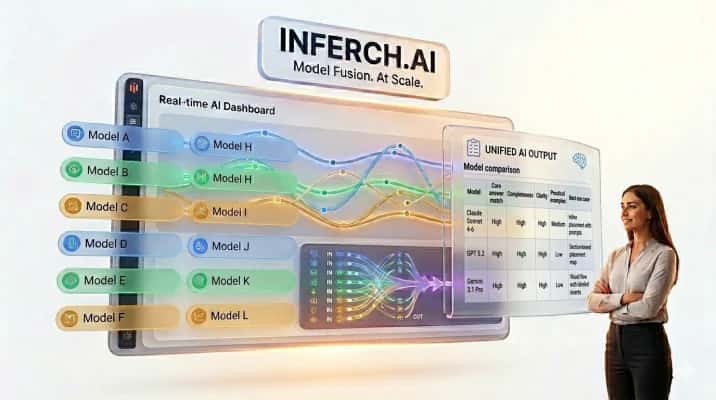
This is the core problem Inferch.ai was built to solve.
Model Fusion is not a feature. It is the founding principle of how Inferch was designed. Running the same workflow across multiple leading models, comparing outputs systematically, extracting the best of each, and delivering a single synthesized result requires significant infrastructure. The alternative — manually querying multiple models and comparing results — doesn't scale.
Inferch removes that barrier. It orchestrates Model Fusion across the world's leading AI models automatically — surfacing where they agree, flagging where they diverge, and fusing the strongest elements of every model into output that is genuinely enterprise-grade. It is the trust layer that makes your entire agent stack governable at scale, without adding operational overhead.